
Home » Our Ecosystem » Community Life » Family Services
A strong Muslim community preparing generations of leaders contributing to prosperity for all Canadians.
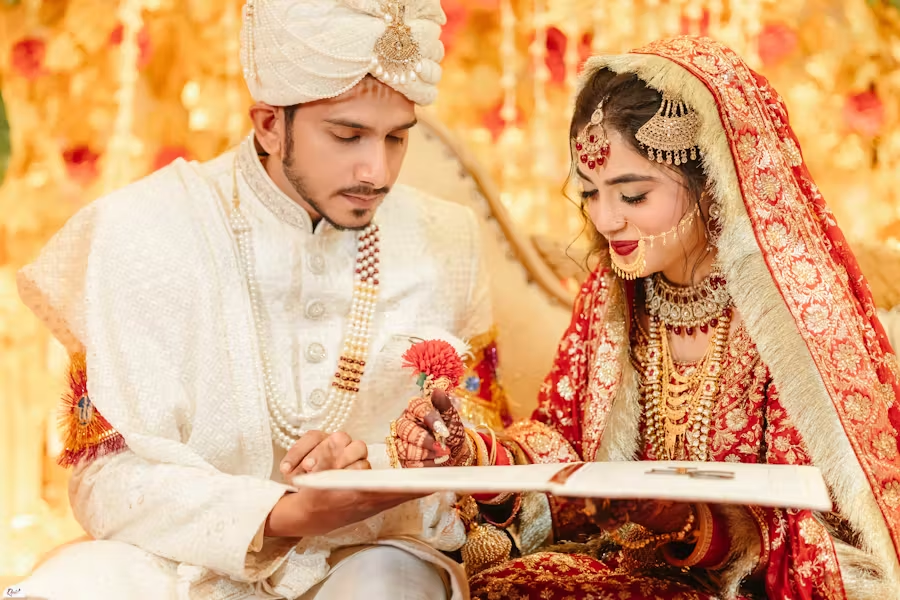
In Islam, marriage is considered both a social agreement and a legal contract. In modern times, the marriage contract is signed in the presence of an Islamic judge or an Imam who is familiar with Islamic law.
In Islam, marriage is considered both a social agreement and a legal contract. In modern times, the marriage contract is signed in the presence of an Islamic judge, or an Imam, who is familiar with Islamic law. The process of signing the contract is usually a private affair, involving only the immediate families of the bride and groom. The contract itself is known as nikah.
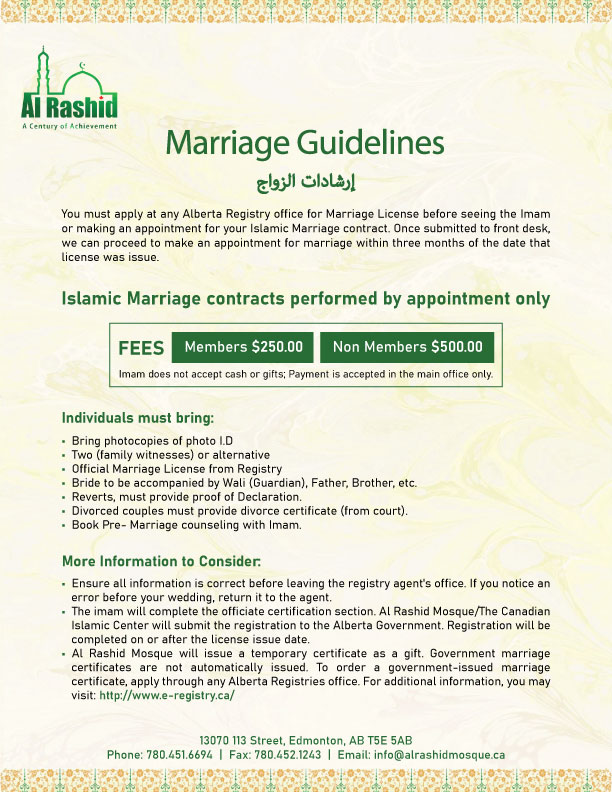
Our clergy can help couples start their journey in life together in accordance with Islamic requirements and laws of Alberta, and developing personalized Nikkah (marriage) contract. It is important that both parties understand the process and be guided through relevant Islamic teachings. The ceremony includes a short reminder of each other’s role, commitment and responsibilities.

When a marriage is in danger, couples are advised to pursue all possible remedies to rebuild the relationship. Divorce is allowed as a last option, but it is discouraged. The Prophet Muhammad once said, “Of all the lawful things, divorce is the most hated by Allah.”
For this reason, the first step a couple should make is to really search their hearts, evaluate the relationship, and try to reconcile. All marriages have ups and downs, and this decision should not arrive easily. Ask yourself, “Have I really tried everything else?” Evaluate your own needs and weaknesses; think through the consequences. Try to remember the good things about your spouse, and find forgiveness patience in your heart for minor annoyances. Communicate with your spouse about your feelings, fears, and needs. During this step, the assistance of a neutral Islamic counsellor may be helpful for some people.
If, after thoroughly evaluating your marriage, you find that there is no other option than divorce, there is no shame in proceeding to the next step. Allah gives divorce as an option because sometimes it is truly the best interest of all concerned. Nobody needs to remain in a situation that causes personal distress, pain, and suffering. In such cases, it is more merciful that you each go your separate ways, peacefully and amicably.
Recognize though, that Islam outlines certain steps that need to take place both before, during, and after a divorce. The needs of both parties are considered. Any children of the marriage are given top priority. Guidelines are given both for personal behaviour and the legal process. Following these guidelines may be difficult, especially if one or both spouses feel wronged or angry. Strive to be mature and just. Remember Allah’s words in the Quran: “The parties should either hold together on equitable terms or separate with kindness.” (Surah al-Baqarah, 2:229)
The Quran says: “And if you fear a breach between the two, appoint an arbiter from his relatives and an arbiter from her relatives. If they both desire reconciliation Allah will effect harmony between them. Verily Allah has full knowledge, and is aware of everything.” (Surah An-Nisa 4:35)
A marriage and a possible divorce involve more people than just the two spouses. It affects children, parents, and entire families. Before a decision is made about divorce, then, it is only fair to involve family elders in an attempt at reconciliation. Family members know each party personally, including their strengths and weaknesses, and would hopefully have their best interests at heart. If they approach the task with sincerity, they may be successful in helping the couple work their issues out.
Some couples are reluctant to involve family members in their difficulties. One must remember, though, that a divorce would affect them as well—in their relationships with grandchildren, nieces, nephews, etc. and in the responsibilities, they would face in helping each spouse develop an independent life. So the family will be involved, one way or the other. For the most part, family members would prefer the opportunity to help while it is still possible.
If this attempt fails, after all due efforts, then it is recognized that divorce may be the only option. The couple proceeds to a divorce. The procedures for actually filing for divorce depend on whether the move is initiated by the husband or the wife.
When a divorce is initiated by the husband, it is known as talaq. The pronouncement by the husband may be verbal or written, and should only be done once. Since the husband is seeking to break the marriage contract, the wife has full rights to keep the dowry (mahr) paid to her.
If the wife initiates a divorce, there are two options. In the first case, the wife may choose to return her dowry to end the marriage. She forgoes the right to keep the dowry since she is the one seeking to break the marriage contract. This is known as khul’a. On this topic, the Quran says, “It is not lawful for you (men) to take back any of your gifts except when both parties fear that they would be unable to keep the limits ordained by Allah. There is no blame on either of them if she gives something for her freedom. These are the limits ordained by Allah so do not transgress them” (Quran 2:229).
In the second case, the wife may choose to petition an Imam for divorce, with a cause. She is required to offer proof that her husband had not fulfilled his responsibilities. In this situation, it would be unjust to expect her to also return the dowry. The Imam makes a determination based on the facts of the case and the law of the land.
In Canada, a separate legal process of divorce is required. This usually involves filing a petition with a local court, or a registry observing a waiting period, attending hearings, and obtaining a legal decree of divorce. This legal procedure may be sufficient for an Islamic divorce if it also satisfies Islamic requirements.
In any Islamic divorce procedure, there is a three-month waiting period before the divorce is finalized.
After a declaration of divorce, Islam requires a three-month waiting period (called the iddah) before the divorce is finalized.
During this time, the couple has time to calm down, evaluate the relationship, and perhaps reconcile. Sometimes decisions are made in haste and anger, and later one or both parties may have regrets. During the waiting period, the husband and wife are free to resume their relationship at any time, thus ending the divorce process without the need for a new marriage contract. (But they must record the reconciliation with the Imam)
Another reason for the waiting period is a way of determining whether the wife is expecting a child. If the wife is pregnant, the waiting period continues until after she has delivered the child. During the entire waiting period, the wife has the right to remain in the family home and the husband is responsible for her support.
If the waiting period is completed without reconciliation, the divorce is complete and takes full effect. The husband’s financial responsibility for the wife ends, and she often returns to her own family home. However, the husband continues to be responsible for the financial needs of any children, through regular child support payments.
In the event of a divorce, children often bear the most painful consequences. Islamic law takes their needs into account and makes sure that they are cared for.
The financial support of any children—both during a marriage or after divorce—rests solely with the father. This is the children’s right upon their father, and courts have the power to enforce child support payments, if necessary. The amount is open for negotiation and should be in proportion to the husband’s financial means.
The Quran advises the husband and wife to consult each other in a fair manner regarding their children’s future after divorce (2:233). This verse specifically holds that infants who are still nursing may continue to breastfeed until both parents agree on the period of weaning through “mutual consent and counsel.” This spirit should define any co-parenting relationship.
Islamic law stipulates that physical custody of the children must go to a Muslim who is in good physical and mental health and is in the best position to meet the children’s needs. Different jurists have established various opinions on how this might best be done. Some have ruled that custody is awarded to the mother if the child is under a certain age, and to the father if the child is older. Others would allow older children to express a preference. Generally, it is recognized that young children and girls are best cared for by their mother.
Since there are differences of opinion among Islamic scholars about child custody, one might find variations in local law. In all cases, however, the main concern is that the children are cared for by a fit parent who can meet their emotional and physical needs.
After the waiting period is over, the divorce is finalized. It is best for the couple to formalize the divorce in the presence of the two witnesses, verifying that the parties have fulfilled all of their obligations. At this time, the wife is free to remarry if she wishes.
Islam discourages Muslims from going back and forth about their decisions, engaging in emotional blackmail, or leaving the other spouse in limbo. The Quran says, “When you divorce women and they fulfill the term of their Iddat, either take them back on equitable terms or set them free on equitable terms; but do not take them back to injure them, (or) to take undue advantage. If anyone does that, he wrongs his own soul…” (Quran 2:231) Thus, the Quran encourages a divorced couple to treat each other amicably, and to sever ties neatly and firmly.
If a couple decides to reconcile, after the divorce is finalized, they must start over with a new contract and a new dowry (mahr). To prevent damaging yo-yo relationships, there is a limit on how many times the same couple may marry and divorce. If a couple decides to remarry after a divorce, this can only be done twice. The Quran says, “Divorce is to be given two times, and then (a woman) must be retained in a good manner or released gracefully.” (Quran 2:229)
After divorcing and remarrying twice, if the couple then decides to divorce again, it is clear that there is a major problem in the relationship! Therefore in Islam, after the third divorce, the couple may not remarry again. First, the woman must seek fulfillment in marriage to a different man. Only after she is divorced or widowed from this second marriage partner, would it be possible for her to reconcile again with her first husband if they choose.
This may seem like a strange rule, but it serves two main purposes. First, the first husband is less likely to initiate a third divorce in a frivolous manner, knowing that the decision is irrevocable. One will act with more careful consideration. Secondly, it may be that the two individuals were simply not a good match for each other. The wife may find happiness in a different marriage. Or she may realize, after experiencing marriage with someone else, that she wishes to reconcile with her first husband after all.
Family life is central to faith, belonging, and well-being. Through Family Services, Al Rashid Mosque offers Islamic guidance and pastoral care to individuals, couples, and families navigating important life moments and transitions.
These services are rooted in Islamic teachings and delivered with compassion, discretion, and respect. Whether someone is seeking religious advice, preparing for marriage, experiencing marital challenges, or navigating separation, Family Services exist to provide clarity and support grounded in dignity and care.
Every family’s situation is unique. Our approach recognizes the complexity of relationships and the importance of guidance that is both faith-informed and responsive to lived realities in Canada.
Family Services bring together religious guidance, pastoral care, and life-cycle support offered through the mosque’s Imams and clergy team. Support is provided through private consultations, religious officiation, and guidance on Islamic processes.
Where needs extend beyond religious or pastoral guidance, individuals and families may also be referred to culturally responsive counselling, mediation, or social services. These referrals are offered thoughtfully and with care, recognizing the importance of holistic and appropriate support.
All services are provided with a commitment to confidentiality, fairness, and respect for those involved.






Family Services are offered with the understanding that these moments are often deeply personal and emotionally complex. The clergy team approaches each situation with compassion, discretion, and a commitment to justice and kindness.
When appropriate, families may be supported through referrals to trusted, culturally responsive professionals and community services, ensuring that care extends beyond the mosque and remains responsible, ethical, and supportive of long-term well-being.